A Beautiful View
A Beautiful View
Written and directed by Daniel MacIvor
Ruby Slippers Theatre
Performance Works
Dec 4 to Dec 13, 2009
Also at the Shadbolt Centre for the Arts
Dec 16 to 19.
Vancouver, BC: Start with a script written by one of Canada's iconic playwright/actors and directed by the playwright himself. Feature two compelling powerful female actors with hugely synergistic on-stage chemistry in a small theatre setting where every nuance of their performance can be seen. And focus on the ebb and flow of an intimate relationship between these two women, from casual meeting, to sexual encounter, touching on friendship, love, attraction, trust and mistrust. My expectations were high - I was expecting truly to be blown away by this play. But I confess I just did not get it.
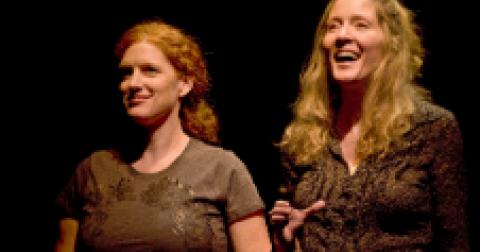
Colleen Wheeler is "Linda" and Diane Brown is "Mitch". The telling of their story is framed by a camping trip where they have come together to talk about what happened at a Halloween party that disrupted their relationship that had developed over some twenty years.
For the first maybe five minutes there is silence. Wheeler connects with the audience with minute facial gestures, sideways looks, a twitch of the mouth. This opening night audience is theatre savvy - we know we are supposed to feel uncomfortable and restless so nobody moves a muscle. As the minutes pass, an occasional laugh or a nervous giggle is heard from different seats.
Frozen
Frozen by Bryony Lavery
Directed by Renée Iaci
shameless hussy productions and Theatre at UBC
Dorothy Somerset Studio, UBC
Sept 22 to Oct 3rd, 2009.
Vancouver, BC. Bryony Lavery 's play has all the elements that should make for compelling theatre. An tragic situation connecting three characters - a serial killer, the mother of the girl he abducted and the academic who is studying him and others like him; and issues that one can argue endlessly : is he evil or is he sick? Can he be forgiven, should he be forgiven and what does forgiveness really mean?
Yet when I left the theatre instead of being engaged in the tragedy of the story and the complexity of the issues, I found myself instead wrestling with the question of what, for me is compelling theatre- the sort of show, specifically a dramatic play, that makes me walk away thinking - wow that was good.
As a splitter not a lumper, I tend to divide plays into three categories. First there is the play that captures me so completely, intellectually and emotionally, that I am almost living the experience with the actors. Then there is the work that engages me intellectually so that I have lots to think and talk about, but it does not touch my heart.
Emily - New York theater

Emily by Chris Cragin
Directed by Steve Day
Firebone Theater
Theatre Row, 42nd St, NY
September 13, 2009
New York, NY: I had only the vaguest knowledge about the life of Emily Dickinson, who posthumously came to be considered one of America's major poets. I knew that in her latter years she had become reclusive and eventually did not leave her house but I knew little else of her history. So I eagerly anticipated my visit to Theatre Row to see this new play by emerging playwright, Chris Cragin.
Theatre Row is a great asset for smaller theatre companies. It houses 5 theatres ranging in seating capacity from 55 to 199 seats. I saw Ascension, an excellent production, in The Lion on my last visit, and Emily is running in The Kirk. It is a long narrow theatre that seats about 90 people and it was almost full. Nice for a Sunday matinee of a new play.
A Steady Rain - New York theater
A Steady Rain by Keith Huff
Directed by John Crowley
Gerald Schoenfeld Theatre,
236 West 45th St., NY
Sept 12 In preview: opening September 29th, 2009
New York, NY. Two men seated on an otherwise empty stage - the playing space surrounded by black drapes, briefly opened to reveal tall buildings on either side of a dark alley, or briefly lluminated to create the illusion of a forest. No props, no fancy set, nothing to draw our attention away from the two Chicago beat cops, relating the events of a summer when the rain poured incessantly and the world as they knew it came crashing down on them.
A Steady Rain runs about 90 minutes without intermission, and I was mesmerized for the entire time. The play is still in preview, which started two days ago, but Daniel Craig (Joey) and Hugh Jackman (Denny) produced outstanding performances, worthy of Keith Huff's well crafted script. The play was directed by John Crowley, whose work I last saw in the 2005 Broadway production of Martin McDonagh's The Pillowman.
Denny and Joey have been friends since childhood. Now they are partners, patrolling the streets of Chicago and standing back to back against the enemy on the streets; drug dealers, gangster, pimps. Sadly for them, times have changed - affirmative action quota systems govern promotion - words they grew up with are now considered politically incorrect or racist - and the "enemy" against whom they must stand together, includes their captain and the police department bureaucracy.
Emil Sher: Author of Mourning Dove and Hana's Suitcase and other works
The Creators: One-on-one with Emil Sher, author of Mourning Dove and Hana's Suitcase 
Among the many excellent productions in Vancouver in 2008, Pacific Theatre’s staging of Emil Sher’s Mourning Dove touched my heart and mind most deeply. I loved the play and the restrained sensitivity with which the writer addressed the unfolding of a tragedy that no parent should ever have to experience. When I realized that Sher was also the author of Hana’s Suitcase, another very moving play that I had recently read, I was compelled to read more of his work. These experiences raised a whole lot of questions that I wanted to pose to the playwright. To my delight, Emil Sher generously agreed to be interviewed for “Creators and Communicators,” the section of Theatre Seen that highlights the creative artists that “make theatre.”
One-on-one with Emil Sher
Emil, I note that your undergraduate degree from McGill was in English and that you taught English in Botswana before returning to do an MFA in Creative Writing at Concordia. Was it your experiences in Botswana that stimulated your desire to write or were you compelled to write from childhood?
Initially, I had contemplated becoming an actor, and focused on theatre as an undergraduate at McGill. But during my time there I became increasingly drawn to the written word, and wrote a fair bit for the McGill Daily, the school newspaper. And as much as I enjoyed journalism (I still find creative non-fiction very gratifying), there is something about the latitude of fiction that always appealed (and I use the word ‘fiction’ loosely to include work for stage and screen). I went to Botswana naively believing I would have time to write, though I wasn’t quite sure what I was going to write about (never a good start for a writer). I soon discovered that teaching is a craft like any other, and required substantial amount of time, energy and care if I was going to do it right. I knew the only way I would be able to write meaningfully was to immerse myself in an environment where I would have to write on a regular basis, and graduate school was the ideal opportunity to do just that. I focused on fiction (my thesis was a collection of short stories) and made a decision upon graduating that I would write in different genres, as the spirit moved me and as opportunities surfaced.
You have written plays for both radio and stage. Could you comment on how your approach differs between writing for radio - theatre of the mind - versus a play that is intended to be physically staged?
Every genre of writing comes with its own toolbox, and I’m still learning how to take advantage of the tools at my disposal. Indeed, I’ve come to see the writing life as a lifelong apprenticeship. What I love about radio is how the narrative is distilled to sound, or silence: a voice, a sound effect, or a moment when nothing is said, when nothing is heard, and yet it is a moment that speaks volumes. Radio has been called “theatre of the mind” for good reason, and it insists that the audience actively engage with the story. Engaging an audience or a reader is essential to how I write, regardless of the genre or the audience I am writing for (which is sometimes as young as pre-schoolers). It is this objective that dictates my approach to radio dramas and stage plays. With radio, I’m more conscious of how dialogue is the foundation upon which the story rests. There is nothing else to create the world of a radio play but for sound, human or otherwise. And so the challenge is to make sure each word and sound can be justified. The intimacy of the medium demands it. With a stage play, I feel the text is but one part of a larger narrative. The set, the lighting design, the very presence of an actor significantly alters our interpretation of the story being told. When I write a play I’m mindful of the varied elements that will ultimately shape it, and am inspired by the collective energies that fuel a stage work. And while it takes a team effort to create a radio play, the process feels more contained, compared to the open-ended development of a stage play, which is often defined – and enriched – by the detours that surface during roundtable, workshop discussions about the text, generating questions that challenge me to justify my creative choices, revisit them, or reject them.
Have you ever directed any of your own plays?
I’ve yet to direct one of my own plays, and feel more drawn to directing a film. I’m especially drawn to the editing process. I said as much to a talk I once gave to a group of theatre students, and one student remarked that editing is not unlike writing, in that it speaks to the importance of structure. It’s often said that writing is rewriting, and that’s not dissimilar to sitting in an editing suite, rearranging a narrative so that it’s a structurally sound as it can be.
As a working contemporary Canadian playwright do you always present a completed script or do you ever work with a director as a dramaturge to massage and shape the script on its feet?
When it comes to a new play, I offer directors a completed script insofar as it’s a draft we can build upon. Initially, the conversation is between myself and the director, who may or may not double as a dramaturge. In some instances, the three of us – playwright, director, dramaturge – have discussed a script in its formative stages. That process is further enriched through workshops, where the script is given a reading by actors who may have their own insights to offer. I see this process as very fluid: changes are made to the script that usually stem from questions posed by the director, an actor, or myself. Scenes are dropped, or rearranged or cut. It takes several drafts before I’m satisfied, and often there’s a substantial rewrite somewhere along the way. My guiding principle when developing a script with collective input can be distilled to a simple question: “Does it serve the story?” Not an actor’s ego or a director’s agenda, but the story.
Or from another perspective: When you hand over your work to a director do your scripts feel complete? Or do you find that as you watch them unfold, there are changes you want to make or other stories that grow out of what you see on stage?
Is a script ever complete, or completely finished? There comes a time when the creative process has run its course and it’s time to let go. There’s always the liability that a script can take too long to gestate, that it can be overwritten and overworkshopped. That said, I have made script changes from one production to the next for all my plays. There is always a word or a phrase that can be tweaked or parsed, and I find this aspect of playwriting very gratifying: the script isn’t static. It can become stronger with each successive staging, and thus become a different play each time.
Review From The House: Palace of the End
Palace of the End by Judith Thompson
Directed by David Bloom, Katrina Dunn, Mindy Parfitt
PAL Theatre, Cardero Street
Touchstone Theatre with Felix Culpa and Horsehoes & Hand Grenades Theatre
May 21 to June 6, 2009
Vancouver, BC: This production of Palace of the End is a simply stunning theatrical experience. Thompson has crafted three powerful monologues based on three real people each with a connection to contemporary Iraq and all three monologues are superbly performed. Although based on news stories and research, as Thompson remarks in the playwright's notes - "the persona ...of each speaker has been created by me." And of course the words they speak spring from her imagination. Yet for me the authentic voices of these three characters ring out in a compelling and utterly believable way.
My Pyramids portrays Lynndie England, the young American soldier who justly or not, became the media symbol of the soldiers charged with abusing Iraqi prisoners at Abu Ghraib prison. Thompson imagines her on office duty, awaiting trial, after fellow reservist Charles Graner the man who impregnated her, (later to marry another fellow soldier), has been jailed for his part in the abuse.
Tags
Review From The House: Antigone Unbound
Antigone Unbound based on Sophocles Antigone Devised and performed by Lesley Ewen, Billy Marchenski, and Tanya Marquardt
and directed by Stephen Hill
Leaky Heaven Studio above the Russian Hall
Leaky Heaven Circus
May 13 to 24, 2009
Vancouver, BC: One never knows quite what to expect in a production by this interesting group of artists, and this time was no exception. Climbing up the stairs to the performance space, I enter a small somewhat claustrophobic room. A narrow platform next to the walls runs round the room leaving a central square pit in which swivel office chairs are haphazardly crammed. We take two seats at the back of the room just in front of the stage manager's table and watch as the place fills up rapidly. It is warm and stuffy but there is a buzz in the air.
I am intrigued to see what they will do with Sophocles' tragic heroine. The back legend goes like this: Antigone, her sister Ismene, and her brothers, Eteocles and Polyneices, are the children of the unknowingly incestous marriage of Oedipus and his mother, Jocasta. When the truth is disovered Oedipus blinds himself after Jocasta kills herself. As heirs to the throne the two brothers agree to alternate as ruler. The older Eteocles however declines to let Polyneices take his turn and Polyneices promptly heads off to Argos, marries the King's daughter and returns with an army to take Thebes by storm. Both brothers die in battle, and Creon, Jocasta's brother, takes over as king of Thebes. He decrees that Eteocles should be buried with full honours, but that the body of Polyneices, whom he considers a traitor, must be left to rot unburied, thus denying him entrance to the land of the dead.